
The number fixed to your door or mailbox is more than a postal convenience. In Vedic numerology, known as sankhya shastra, every digit from one to nine is thought to carry a particular quality, and the number of your dwelling is said to colour the atmosphere within. Families who consult our Numerology service often ask whether their address supports what they hope to do there—raise children, work from home, recover health, or simply rest.
This article explains how house number numerology works, what each digit is traditionally said to encourage, and how people living in apartments or shared buildings apply the practice when the address is long or layered.
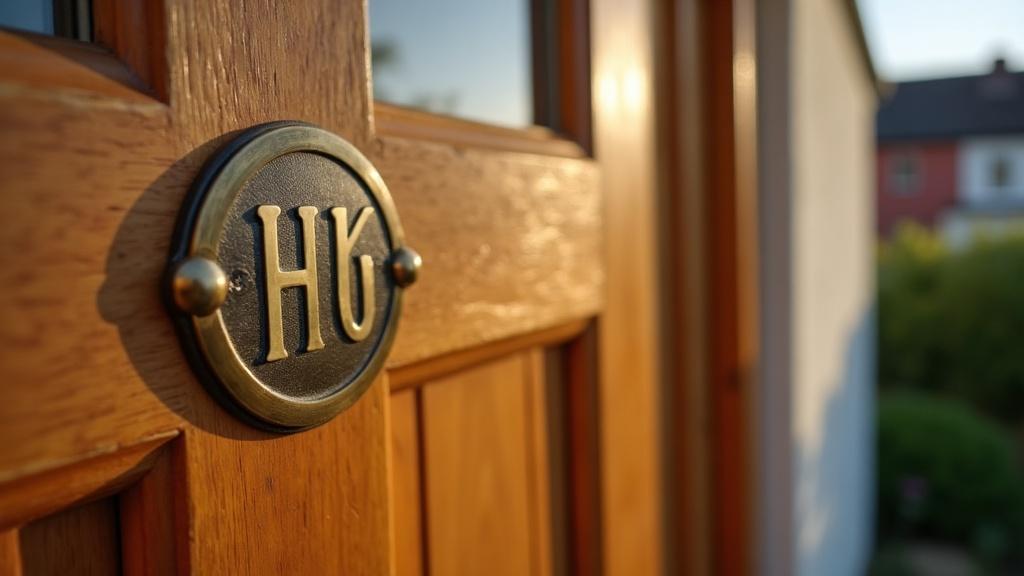
How the house number is calculated
You reduce your street number to a single digit by adding each numeral until only one remains. If you live at 428, add four plus two plus eight to get fourteen, then one plus four to reach five. The house is called a five. If the sum is eleven, twenty-two or thirty-three, some practitioners pause there and call these master numbers, though classical texts do not make that distinction. For an apartment, add the unit number to the building number, then reduce. In a building at 1550, unit 304 becomes one plus five plus five plus zero plus three plus zero plus four, which totals eighteen, then nine.
When the postal address includes letters or a fraction—12A or 45 and a half—most numerologists ignore the letter and round the fraction to the nearest whole number. There is no single rule handed down; regional custom varies.
The nine house numbers and their traditional qualities
| Number | Planet | Said to encourage | Considerations |
|---|---|---|---|
| 1 | Sun | Independence, leadership, new ventures | Can feel solitary; not always restful |
| 2 | Moon | Partnership, sensitivity, hospitality | May amplify emotion and indecision |
| 3 | Jupiter | Creativity, communication, social life | Lively but sometimes scattered |
| 4 | Rahu | Discipline, structure, steady work | Can feel heavy or slow to change |
| 5 | Mercury | Movement, variety, quick thinking | Restlessness; frequent visitors |
| 6 | Venus | Harmony, beauty, family life | Nurturing but can become overly focused on appearance |
| 7 | Ketu | Reflection, study, spiritual practice | Quiet, sometimes isolating |
| 8 | Saturn | Ambition, material growth, resilience | Demands effort; tests patience |
| 9 | Mars | Energy, courage, completion | Intense; not always peaceful |
These are the broad strokes. A house number does not determine your fate; it is thought to tint the environment in which you live.
When the number feels mismatched
If your house number seems at odds with your circumstances—a restless five when you need stillness, or a solitary one when you long for company—tradition offers small adjustments. Painting the number in a colour associated with a balancing planet, placing a small symbol near the door, or writing the number in a particular script are common practices. Some families hang a secondary number inside the entrance, choosing a digit that complements the outer one.
None of this replaces the work of making a home livable. If the plumbing leaks or the neighbours are unkind, numerology will not fix it. These practices are about aligning intention with environment, not substituting effort with symbolism.
Apartment buildings and shared addresses
In a high-rise, your unit number matters more than the building number, because that is the threshold you cross daily. A building at 2000 with units in the hundreds creates many different energies under one roof. Some residents add only their unit digits; others include the building number and accept a higher total. There is no orthodox method for this, because the texts were written for villages and single dwellings.
If you share a house and each tenant has a letter designation, reduce your letter to a number by its place in the alphabet—A is one, B is two—and add it to the street number. Again, this is adaptation, not scripture.
How this fits with Vastu
Vedic architecture, or Vastu, concerns the placement of rooms, the orientation of the building, and the flow of the five elements through space. House number numerology is a separate discipline, though both rest on the idea that environment shapes experience. A well-oriented home with a difficult number is still better than a poorly oriented home with a favorable one. When families ask us to review both, we look at Vastu first, because structure is harder to change than a painted digit. Our Vastu service addresses layout and direction; numerology fine-tunes the smaller details.
Working with your number in a new country
If you have moved from India to Toronto or Edison and your address feels unfamiliar, remember that the principles travel. The number on your townhouse in Brampton is read the same way as the number on a gate in Chennai. What changes is context: apartments instead of compounds, zoning rules instead of family land, and the need to practice quietly when neighbors do not share the vocabulary. You may not be able to paint the building number, but you can choose how you write it on a nameplate or welcome mat, and you can set an intention each time you unlock the door.
Numerology is not magic. It is a framework for paying attention.
A short closing thought
The number on your door is fixed by the municipality, not by you. What you do with that number—whether you learn its traditional meaning, adjust your space to balance it, or simply let it be—is a choice. Vedic numerology offers a lens, not a mandate. If the teaching helps you feel more at home, use it. If it does not, the door opens just the same.