1. Why This Article Exists
If you grew up in an Indian household — whether in Chennai, Chandigarh, or Calgary — there is a very high probability you have heard more than one word used for the exact same piece of paper.
Your grandmother in Kerala may call it a Jathakam. Your cousin in Delhi strictly says Kundli. An aunt in Kolkata refers to hers as a Kushti, a friend's Gujarati family discusses their Janmakshar, and an online profile tool simply outputs a birth chart. If you have ever quietly wondered, "Are these all the same thing, or am I missing something structural?" — you are definitely not alone.
This linguistic confusion compounds with each generation and every move across a border. Inter-state marriages bring two entirely different regional vocabularies under one roof. Second-generation children growing up in Canada, the US, the UK, the UAE, or Australia may not read the regional scripts their elders use, yet they must decipher three or four different terms thrown around on the family WhatsApp thread.
The goal of this article is to lay out a single, calm, respectful map of these terms. No hierarchy, no claims of one tradition being the "true" or "original" variant. We are here to show you how they all beautifully connect.
2. What Is a Kundli? (The Umbrella Idea)
Let us begin with the word that serves as the most common entry point online: Kundli (also spelled Kundali).
The word traces its lineage back to the Sanskrit root kundalin, which translates to "coiled" — a structural reference to the circular, coiled manner in which ancient charts were drawn on ancestral scrolls.
To generate one, a modern calculation engine requires exactly three inputs:
- +Date of birth (day, month, and year)
- +Time of birth (as close to the exact minute as possible, noting AM or PM)
- +Place of birth (the specific city and country to establish geographic coordinates and time zone)
No matter which dialect or Indian language your family speaks, the resulting chart maps out the identical foundational components:
- +Navagraha: The nine primary planetary bodies
- +Rashis: The twelve distinct zodiac signs
- +Bhavas: The twelve houses governing different areas of life
- +Nakshatras: The twenty-seven lunar mansions or birth stars
- +Lagna: The ascendant or rising sign on the eastern horizon
- +Dashas: The systemic planetary time cycles
3. What Is Janam Kundli / Janam Kundali?
You will frequently encounter the elongated terms Janam Kundli, Janam Kundali, or Janma Kundali.
Breaking down the vocabulary:
- +Janam / Janma: Means birth (derived directly from Sanskrit and adapted across the majority of Indian languages)
- +Kundali: Means chart or diagrammatic representation
Therefore, Janam Kundali translates cleanly to "birth chart."
This phrasing is the primary standard across the Hindi-speaking belt — including Delhi, Uttar Pradesh, Madhya Pradesh, Rajasthan, Bihar, Uttarakhand, Jharkhand, Himachal Pradesh, and Haryana. It is also the baseline operational term used by formal pan-Indian Vedic institutions. If you are looking for a universally recognised, neutral term to use with acquaintances from any Indian state, Janam Kundali or birth chart is an excellent choice.
4. What Is Jathakam?
Jathakam is the predominant term used within Tamil and Malayalam households — written natively as ஜாதகம் in Tamil script and in Malayalam script.
It stems directly from the Sanskrit root word jataka, which loosely means "pertaining to birth" or "birth horoscope." It is heavily used throughout Tamil Nadu and Kerala, as well as across the global Tamil and Malayali diaspora in Singapore, Malaysia, the UAE, the UK, Canada, and Australia.
A Jathakam tracks the exact same metrics: your Rasi (Moon sign), Nakshatram (birth star), Lagnam (Ascendant), Navamsam (the D-9 divisional chart), and the Vimsottari Dasha progression. The primary visual difference is that a Jathakam is traditionally laid out in the South Indian fixed-square chart style. When an elder from Chennai or Kochi asks for your chart, Jathakam is the word they are looking for.
5. What Is Jathagam?
This subtle distinction often trips up second-generation individuals trying to type the word phonetically. Jathagam is not a unique, separate astrological chart — it is simply the phonetic transliteration of Jathakam.
In colloquial, spoken Tamil, the character in ஜாதகம் is naturally softened from a harder "ka" sound into a gentler "ga" sound due to the phonetic rules of the language. Consequently, many online astrology portals, regional panchang platforms, and family members spell it out in English characters as Jathagam.
6. What Is Jataka / Jatakam?
Jataka (written natively in Kannada as ಜಾತಕ) is the standard terminology deployed across Karnataka and by Kannada-speaking communities globally.
It shares the exact same linguistic root (jataka) as its Tamil and Malayalam cousins. In local Kannada regional software, you will frequently see the terms Jataka, Janma Jataka, and Janma Kundali sitting comfortably side by side on the exact same page.
Similarly, Telugu-speaking families in Andhra Pradesh and Telangana use the term Jaatakam (జాతకం). Much like the Kannada and Tamil systems, the Telugu tradition calculates the identical planetary degrees and primarily renders them using the South Indian square diagram.
7. What Is Janam Patrika / Janampatri?
Janam Patrika (also abbreviated as Janampatri or Janma Patra) is a highly popular term across Marathi, Gujarati, Hindi, and Rajasthani communities.
Breaking it down:
- +Janam / Janma: Birth
- +Patrika / Patri / Patra: Document, scroll, leaf, or official paper
Thus, it literally translates to "birth document."
In practical use, there is a small shade of difference. While "Kundli" often specifically refers to the square or diamond mathematical chart diagram itself, a Janam Patrika frequently denotes a comprehensive, multi-page printed or handwritten booklet containing the core chart, planetary configurations, transit forecasts, and written explanations. However, many households use Kundli and Janampatri as complete synonyms — so do not stress over the technical divide.
8. Other Regional Names You Might Hear
To appreciate the vast linguistic tapestry of the Indian subcontinent, it helps to recognise the other names passed down through generations:
- +Bengali: Kushti, Kosthi, or Thikuji Kusthi (কুষ্ঠি / কোষ্ঠী). Traditional Bengali astrology documents are historically rendered in a distinct East Indian rectangular or circular format
- +Gujarati: Janmakshar (જન્માક્ષર). This beautifully blends Janam (birth) and Akshar (letters/syllables), referring to the auspicious birth syllables assigned based on the planetary constellation
- +Punjabi: Teva (ਟੇਵਾ). The traditional term used across Punjab for the master birth chart scroll compiled by family astrologers
- +Urdu / Hindustani: Zayecha (زائچہ). A classical astronomical term used within Urdu-medium and syncretic households
9. A Table of Terms by Language and Region
For quick reference, use this simple translation map:
| Term | Script | Primary Language(s) | Primary Regions |
|---|---|---|---|
| Kundli / Kundali | कुंडली | Hindi, Marathi, Odia | North India, Maharashtra, Odisha |
| Janam Kundali | जन्म कुंडली | Hindi, Sanskrit-derived | Universal formal usage, North India |
| Janam Patrika | जन्मपत्रिका | Hindi, Marathi, Gujarati | UP, MP, Rajasthan, Maharashtra, Gujarat |
| Jathakam | ஜாதகம் | Tamil, Malayalam | Tamil Nadu, Kerala; global diaspora |
| Jathagam | ஜாதகம் | Tamil (spoken phonetic) | Tamil Nadu; global Tamil diaspora |
| Jataka / Jaataka | ಜಾತಕ | Kannada | Karnataka; Kannada diaspora |
| Jaatakam | జాతకం | Telugu | Andhra Pradesh, Telangana |
| Kushti / Kosthi | কুষ্ঠি / কোষ্ঠী | Bengali | West Bengal, Tripura, Bangladesh-origin |
| Janmakshar | જન્માક્ષર | Gujarati | Gujarat; global Gujarati diaspora |
| Teva | ਟੇਵਾ | Punjabi | Punjab; global Punjabi diaspora |
| Zayecha | زائچہ | Urdu | Classical Urdu-medium families |
10. Are All These Charts Calculated the Same Way?
Yes. In terms of core mathematical astronomy, they are fundamentally identical.
- +The inputs are identical: every regional variation requires the exact same foundational criteria — calendar date, exact time down to the minute, and the specific city of birth
- +The computational engines are identical: modern calculation software — regardless of whether the visual output interface is in Tamil, Bengali, or English — relies on the Swiss Ephemeris dataset paired with the Lahiri Ayanamsa calculation standard to determine planetary longitudinal degrees
- +The astronomical output elements are identical: every variation tracks the positions of the same 9 planets, across the identical 12 zodiac signs, anchoring the same 27 Nakshatras, and calculating the same Vimsottari Dasha timelines
What creates the slight differences you might notice between two different platforms or family reports usually comes down to three technical choices:
- +Ayanamsa variations: An astrologer or platform might configure calculations to use a different ayanamsa (like Raman or KP) rather than Lahiri. This is a technical choice, not a regional one
- +Planetary nomenclature: The planet Mars will be labelled as Mangal in a Hindi report, Sevvai in a Tamil Jathagam, and Kuja in a Kannada layout. The exact same celestial body, translated
- +Visual diagram formats: The graphical design used to draw the chart boxes on paper
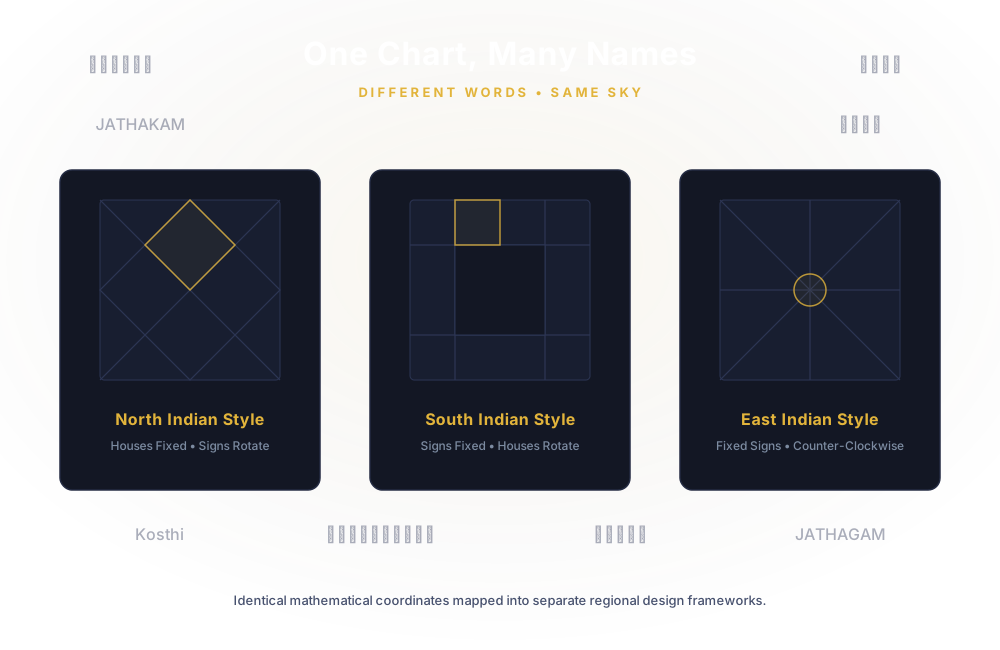
11. North Indian vs South Indian vs East Indian Chart Styles
While the underlying math is identical, the actual visual layouts look dramatically different from one another. No single layout style is more accurate or spiritually superior — they are three distinct artistic conventions for graphing the exact same data points.
North Indian Style (Diamond-in-Square)
In this layout, the 12 houses remain permanently fixed in position. The top-centre diamond shape is always the 1st House (Lagna). The zodiac signs rotate counter-clockwise through the diamonds and triangles, represented by numbers (1 for Aries, 2 for Taurus, and so on) based on which sign was rising on the horizon at birth. This style is the default among Hindi, Punjabi, Gujarati, and Marathi communities.
South Indian Style (Fixed-Square Grid)
In this layout, the 12 zodiac signs remain permanently fixed in position. The grid moves in a clockwise loop. Aries is always anchored in the second box of the top row, Taurus to its right, and so on. The houses rotate instead — the first house is indicated by marking the box of the sign that was rising at birth. This style is universally favoured by Tamil, Malayalam, Kannada, and Telugu families.
East Indian Style (Rectangular Grid)
Popularised in Bengali Kushti and traditional Odia charts, this is a beautiful rectangular grid where the signs remain fixed in position but are read in a counter-clockwise direction. Historically, handwritten ancestral documents often rendered this inside beautifully stylised circular wheels or lotus diagrams.
12. Why the Underlying Idea Is Broadly the Same Across India
How did so many different regions arrive at the exact same systemic calculation? The answer lies in their shared ancestral source texts.
The mathematical architecture of Indian astrology is rooted in the same classic Sanskrit foundational treatises — such as the Brihat Parashara Hora Shastra, Saravali, and Phaladeepika. Because the root formulas are uniform, the core life topics evaluated remain completely consistent across states: self-discovery, compatibility analysis (termed Porutham in the south and Guna Milan in the north), choosing auspicious timing for milestones (Muhurat), and general personal reflection.
The regional variety we see today is simply a reflection of India's beautiful cultural diversity — manifesting in localised scripts, regional calendars, and drawing conventions.
13. Why NRIs and Inter-Regional Families Often Get Confused
Linguistic mix-ups are an incredibly common part of modern family life, and they are completely natural.
- +Inter-regional marriages: When a groom from Delhi marries a bride from Chennai, or a Gujarati professional pairs with a Bengali creative, the families instantly bring two completely different vocabularies to the table. One side requests the Kundli for matching, while the other side is searching for the Jathagam
- +The NRI generational gap: Parents living in global hubs like Toronto, London, New York, or Dubai often use their native regional terms at home. Meanwhile, their children search for information in English online, encountering the word Kundli or Vedic Birth Chart on apps, leaving them unsure if their family's document is the same thing
- +The multi-language WhatsApp thread: A single family group chat can easily contain a grandmother typing in Tamil script about a Jathakam, an uncle replying in English about a Kundli, and an aunt referencing a Kushti
15. How Golden Kundli Helps Multi-Language Families
When a single family spans multiple states, time zones, and languages, Golden Kundli acts as a helpful cultural bridge:
- +Plain English by default: Every summary chart translates complex astrological terms into clear, accessible English — making it easy for grandparents, uncles, and tech-savvy teenagers to read the same document together
- +Universal search integration: The platform treats Kundli, Jathakam, Jathagam, Jataka, Kushti, Janmakshar, and Teva as equal terms. You do not have to guess or navigate complex regional menus
- +Unified family sub-profiles: You can manage profiles for your entire family under a single account and view insights for relatives who prefer different regional terms on one cohesive dashboard
- +AI Corner: Have a specific question about your chart? Ask in plain English without needing to learn complex regional vocabulary first
16. How to Explain This to Your Family — Respectfully
Navigating these conversations with older generations is easy with a few gentle approaches:
- +Start with the common ground: Use simple, unifying phrases like "It is the exact same planetary data underneath — we are just using different regional words to describe it"
- +Match your vocabulary to your audience: When speaking with elders in Chennai, comfortably use the word Jathagam. When speaking with relatives in Delhi, use Kundli. Use birth chart when explaining to friends abroad
- +Avoid ranking traditions: Never claim that one state's drawing style or calendar system is more accurate or authentic than another. They are all beautiful, equal paths tracing back to the same roots
- +Validate their preferences: If an elder insists that their regional word is the only correct one, simply agree respectfully. You can appreciate the cultural term while knowing the underlying math is shared across borders
21. A Calm Closing
The chart your grandmother refers to as a Jathakam, the one your uncle calls a Kundli, and the one your cousin's Punjabi in-laws call a Teva are all looking at the same sky — the sky as it appeared on the exact morning, afternoon, or night you took your first breath.
The beauty of this tradition is not in any single regional name. It is in the idea itself: that a community of people, spread across a vast and linguistically diverse subcontinent, independently developed a shared impulse to look upward at the moment of birth and say — let us remember this exact sky for this person.
Use whatever word feels most natural to you and most comfortable to the person you are speaking with. The tradition holds, regardless of the language you carry it in.